
 Zeetech
 05/10/2026
Fiber Optic Cabling in Dubai: Benefits for Modern Businesses
Fiber optic cabling in Dubai gives your business faster speeds, steadier links, and room to grow. As cloud applications, video conferencing, and data-intensive workloads increase, traditional copper cabling cannot keep up with your business. If video calls freeze or big files crawl, the cabling system behind your wall might be the real problem.
At ZeeTech, we see this all the time. A business buys a faster internet plan, and nothing improves. The old cabling is the bottleneck. Let's learn more about how fiber optic cabling can help your business.
Why Is Fiber Better Than Copper for Business Networks?
Fiber carries more data over longer distances than copper. It also resists electromagnetic interference, so lifts, power cables, and heavy equipment don't scramble your signal. In a busy Dubai tower or a big warehouse, that matters.
Copper weakens as the cable run gets longer. Fiber doesn't have that problem. You can link floors, or even separate buildings, without watching speeds drop.
Picture a road. Copper is a narrow street that clogs fast. Fiber is a wide motorway with space for traffic you haven't planned yet.
What Problems Does a Business Fiber Optic Network Fix?
A business fiber optic network fixes the slow, shaky, messy network setups that wear IT teams down. These are the four problems that bring businesses to us most often:
- Network speeds crawl over long copper runs.
- Links between floors or buildings keep dropping.
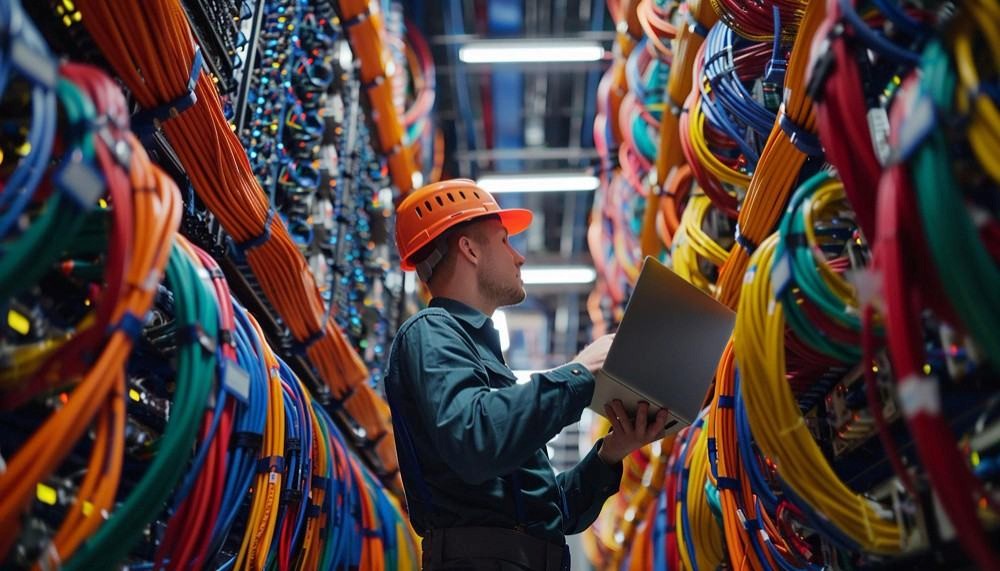
- Server rooms hide unlabeled cables nobody dares touch.
- Nobody has test reports, so nobody can prove how the network should perform.
That last one surprises people. Without documentation, every future fix turns into guesswork.
How Does Fiber Help with Cloud Apps, VoIP, and Video Calls?
Fiber gives modern tools like Cloud Apps, VoIP, and video calls the bandwidth they need to run smoothly. Cloud apps load faster, VoIP calls stay clear, and video meetings stop stuttering when everyone joins at once.
Your team notices it first. Nobody sends an email saying "great cabling." They just quit complaining about that Monday meeting that always freezes.
Growth gets easier too. A properly designed and tested fiber optic cabling system lets you add racks, switches, and new floors without re-cabling the whole building.
What Do Fiber Optic Cabling Services in Dubai Include?
Good fiber optic cabling services in Dubai cover the whole job, not only the pulling. We handle design, fiber optic cable installation, splicing, termination, testing, and maintenance for offices, warehouses, hotels, and enterprise networks.
Here's how that looks on a real project:
- Every job starts with a site survey. Our team walks the routes, risers, and rack layouts, then picks the best fiber type and path.
- Fiber optic cable installation comes next, using proper trays, conduits, and raceways. Cables follow the correct bend radius, and fire-stopping goes in where required.
- Termination follows. Each fiber gets terminated, dressed, and labeled, with patch panels and port mapping so troubleshooting stays simple.
- Backbone links connect your main distribution room to each floor, and to racks and switch uplinks.
- Planning for switches and SFP modules happens early, so the fiber matches the gear it plugs into.
One team handles all of it. That means one accountable outcome, not three vendors pointing at each other.
Single-Mode or Multi-Mode Fiber: Which One Fits Your Building?
Choosing between single-mode and multi-mode fiber really comes down to distance, your network requirements, what equipment you already have, and whatever expansion plans might be on the horizon.
Single-mode fiber, SMF, is built to carry signals over much longer distances with very low signal loss along the way. It's commonly used for connecting separate buildings, running across large campuses, or really any setup where network equipment sits far apart from each other. It also gives you more flexibility down the line if your network ends up needing higher bandwidth or longer links at some point in the future.
Multi-mode fiber, MMF, is generally better suited to shorter connections, think links between network rooms, floors, or equipment within the same building. It can be a practical choice when distances stay limited and the network doesn't really need the extra reach single-mode offers.
That said, the right choice shouldn't come down to distance alone. Your installer should be factoring in building layout, cable routes, required bandwidth, the network equipment involved, installation conditions, and what future requirements might look like too.
A proper site survey is really what helps determine which fiber type actually makes sense for the application at hand. Get the wrong type installed, and you could end up replacing cables, upgrading equipment to stay compatible, or doing extra installation work later on, all of which adds cost and disruption nobody wants to deal with.
Why Does OTDR Testing and Certification Matter?
Testing proves your fiber works the way it should. We test every core with a power meter and light source, add OTDR testing where needed, and verify loss on each link. You get a report with link IDs for handover and audits.
That report pays off later. When something acts up in two years, your IT team checks the numbers instead of arguing about whose fault it is. You get proof of performance, not just an install.
How Does Fiber Optic Installation in Dubai Work, Step by Step?
Our process has four steps, and you always know what's done and what's next.
- Discovery and assessment: Our team reviews your current setup, users, challenges, and priorities.
- Design and plan: You get a practical plan with scope, timeline, and service levels.
- Implementation: We install and test while keeping disruption to your daily work low.
- Handover and ongoing support: Documentation, monitoring (where relevant), and a support plan land in your hands.
Buildings add their own twists. We coordinate with building management, so you don't chase approvals yourself.
Which Dubai Businesses Gain the Most from Fiber?
Fiber optic cabling in Dubai pays off fastest for offices moving into larger or multi-floor spaces. Warehouses and logistics sites benefit too, since they need steady links over long distances.
Retail and hospitality sites come next. Heavy Wi-Fi and POS use put real pressure on a weak backbone. If you're buying new switches or servers, check your cabling first, because new gear can't outrun old cable.
What Should You Ask Before Hiring a Fiber Cabling Company?
Start with testing. Will they certify every core and hand you the reports? Labeling comes next, since unmarked racks cost you hours later. Then find out who supports the network after handover.
At ZeeTech, we bring over 25 years of combined industry experience and work with brands like Cisco, HP, and Microsoft. We price transparently and give honest advice without jargon. We can also tie your fiber optic cabling into IT support, IT AMC, or network security consulting.
Ready to plan? Request a site survey at zeetech.ae, and we'll map your routes, fiber type, and timeline.
FAQs About Fiber Optic Cabling for Businesses
What's the difference between provider fiber internet and fiber optic cabling inside my office?
Provider fiber brings internet into your building. Fiber optic cabling is the internal network that carries data between floors, racks, and switches after it arrives. You can have fast provider fiber and still suffer slow internal links if old copper runs between rooms. Both layers need to be strong for good performance.
Can I upgrade my business fiber optic network to 10G, 40G, or 100G later?
Often, yes. When the fiber type and capacity are planned correctly at the start, you can raise speeds later by changing switches and optics instead of pulling new cable. That's why growth planning belongs in the site survey. A well-designed backbone supports higher throughput as your needs change.
Will fiber optic cabling services in Dubai work with my current switches and servers?
Usually, yes, but it really depends on what ports your equipment actually has. A lot of switches use SFP modules to connect to fiber, so picking the right modules and uplinks matters more than people expect. A technician should go through your switches, servers, and security setup before installation even starts, just to make sure everything actually matches up on the network.
Is fire-stopping required when installing fiber cabling?
Anywhere cables pass through fire-rated walls or floors, yes, fire-stopping needs to seal that gap so smoke and flames can't travel through it. Requirements can differ depending on the building, so installers usually coordinate with building management before any work begins. Skip that step, and you're looking at safety issues and compliance problems down the line.
Does a fiber network need ongoing maintenance?
Fiber lasts a long time, but connectors collect dust, cables get bumped during rack changes, and links change as you add equipment. Regular checks, cleaning, and updated documentation keep small issues small. Many businesses cover this with an annual maintenance contract that gives IT teams a clear contact.


